
| rohatsu
Rohatsu Retreat Preparatory Lessons
Our two day fully online Rohatsu retreat is to be held on the weekend of Saturday & Sunday, December 6th and 7th, 2025. The retreat is designed to be sat “live” in most of America and Europe, but for those in other time zones or who otherwise need, any portions can be sat “live though recorded’” at any time and all times after (no different from the original!) While sitting, just forget about all distance, separation and time.
If you are concerned about the length of sitting, please take to heart that such retreats, of 2 or 3 days, a week or two weeks, are common in the Zen world, and are a powerful practice for those who can do it. It is a practice not to be missed if at all possible for you.
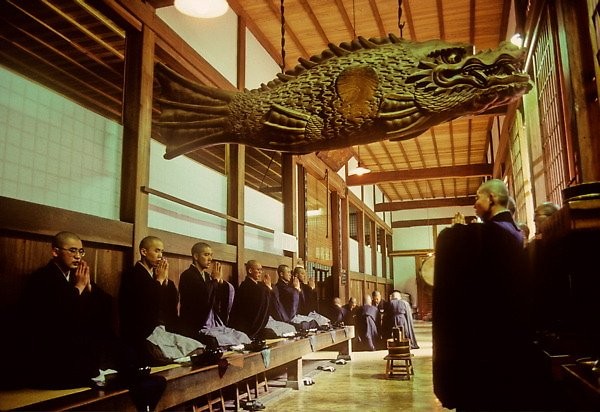
HOWEVER, if it is too much for you, and too difficult for you in health or other ways in life, it is fine to spread the retreat out over several days, or to undertake only those portions which you can manage. Even if you sit or engage only in some sittings and rituals, please place all your heart and sincerity into undertaking those. Look at the full schedule page and identify how and when you will undertake our retreat.
Information on the meaning of Rohatsu Retreat, and easy-to-follow instructions on arranging a quiet space in your home for sitting, are found in the Retreat Pointers document you can download from the Digital Resources section below. Also included are instructions on combining the retreat with parenting and other responsibilities one may have.
The two days will include Zazen sitting, Kinhin, Chanting, Zazen sitting, Oryoki, Zazen sitting, Bowing, Talks, Zazen Sitting, ‘Samu’ Work Practice, and More Zazen Sitting, as in any Soto Zen Retreat, all in celebration of the Buddha’s days of Zazen and Enlightenment under the Bodhi Tree. We also mark the endless-end of our 90 Day Ango with this Retreat.
LET’S GET READY TO ROHATSU!
LESSON 1: ORYOKI
Oryoki is a lovely tradition of formal meal ritual. It is a way of eating with awareness and gratitude and is a common practice during Soto Zen retreats. In our sangha, we undertake this traditional practice as well, adapting it to our unique circumstances.
Please note that this ritual is not meant to be a leisurely, slow lunch, savoring every bite while chewing 100 times. Rather, Zen monks actually treat food as medicine to support the body in practice, and do not think “good or bad” (although the food should be healthy and nutritious) or savor the meal. You might be surprised how fast they go, getting it down bite by bite, but without lingering. Please only prepare food for this ritual that can be eaten fully and cleanly, without much mess, in about 15 minutes. This is a ritual, and may not be sufficient as your actual meal (especially for those with health concerns), so please feel free to prepare and eat any additional food you need during break times on the schedule. If there is need for health or other reasons, it is fine to take additional healthy food or snacks during break times informally (no ritual required than perhaps a grateful Gassho), to sustain you.
Thus, during Oryoki ritual, do not rush and choke, but neither linger. Be sure to serve yourself a small portion, so that one is able to open one’s bowls, eat and finish, then wrap the bowls with everyone within the given time. Small portions are thus suggested, even with the traditional offer of “seconds” midway. No food should remain at the end, when it is time to clean and rewrap. Take enough to sustain you, not fill you.
Jundo Roshi remembers one of his first Oryoki where he was left with half a dish of rice still uneaten when others were already wrapping their bowls, which he nearly choked on trying to then get down … a mistake he says he never made again.
The following video will explain a bit about how to make and use a simple, homemade Oryoki kit. All you need is:
- 1 – Standard Bandana / Clean Standard Pillow Case
- 2 – Three Nested Bowls, (e.g. 2 Bowls and 1 Tea Cup that fit into each other)
- 1 – Cloth Napkin (Clean Standard Pillow Case)
- 1 – Small Wiping Cloth (Men’s Handkerchief)
- 1 – Table Spoon
- 1 – Tea Spoon or Chop Sticks
- 1 – Small Cut Piece of a New Sponge or a Silicone/Plastic Spatula
- 1 – Letter Envelope
- 1 – A small dish on the side for the “Hungry Ghosts”
- 1 – Water Container – easy to pour in and out of.
Here is a little demonstration of simple Oryoki. The video has subtitles, in case anyone needs them.
LESSON 2: SAMU
Let’s look at work practice, Samu, which will be part of our Rohatsu Retreat.
While Zazen is at the heart of our Way, other aspects of traditional Zen Practice are also “Zazen Off The Cushion”. The vital and energetic non-doing of ‘Samu‘ traditional work practice is so.
Samu is well described in this excerpt:
“Samu is manual work done with the same concentration as zazen. All masters of transmission, especially Master Hyakujo (720-814), have insisted on this. Even in his old age, Master Hyakujo worked every day in the field with his students. One day, they hid his tools, thinking that their master should spare himself. Hyakujo declared: “A day without working, a day without eating.” And he stopped eating until his disciples gave him back his tools.
In zen, work has great value, because it allows us to practise the Way in action. In the dojo and during retreats (sesshins), zazen is followed by samu, which is when we do the chores to ensure the smooth functioning of communal life. Samu also means putting our efforts at the service of the community, without expecting anything in return.” From Zen, by Bovay, Kaltenbach and De Smedt, Albin Michel Publishing, 1993
Yes, Samu is just Zazen in action. It may not look like Zazen, but it is to be done from the same state of mental balance. Couple this with an attitude of goalless, non-striving, ‘just doing’, also a hallmark of Zazen. As well, work is to be performed mindfully, as the only action in and of the whole universe : One engaged in Samu should devote to it all care and attention, never wishing for or thinking of anything else in that moment of action.
The result is a job performed diligently and patiently and with certain goals, but with no thought of anything to achieve (of course, not a contradiction in Zen). It may be a continuing job that just needs to be done without end, but we do it with all care moment by moment by moment for the time we have.
We usually describe Samu in a nutshell as working diligently and carefully at one’s task trying to get it done, all while, simultaneously, dropping all thought of any goal to attain or anywhere to get! (Yes, seems contradictory, like seeing things two ways at once, as one.)
All Good Samu, All Good Practice!
For example, we clean the dishes trying to get them clean (because nobody wants filthy dishes!), all the while dropping all thought of “clean” vs. “dirty” and anything to achieve, thereby achieving a certain purity that sweeps in and through both clean and dirty. Thus, we achieve a clean that cleans up as both clean and dirty!
Those parents and workers with heavy family or employment duties even during a Retreat can make that part of that their ‘Samu’, approaching it with the mindset described above. Treat every changed diaper, cooked meal and bedtime story read during the Retreat as ‘Samu’. Treat every staple stapled, copy made on the copy machine, customer greeted as ‘Samu’ if needing to work during part of the ‘Retreat’.
Jundo Roshi says “In years past, I have gathered fall leaves and cleaned the bathtub (an activity, frankly, I usually do not enjoy!) … Now, if you can, and the weather permits, it is lovely to do some outdoor work for Samu. Or one can clean (beyond “clean vs. dirty”) around the house.“
However, if someone has physical or other limitations, even small tasks are fine. Those with health and other physical restrictions should find some work that they can do easily, seated or without strain, not too demanding on the body. Samu can be small and careful, and need not be too demanding of strength and stamina. We have had folks fold socks in bed, or clean a drawer or polish small coins, but with a sincere and dedicated heart. If someone has a health condition or disability, they can just do what they can and the body allows. No problem. Design your own work project that you feel comfortable with. Here is our Shokai to demonstrate a simple task while seated
LESSON 3: GATHAS AND NATURE CALLS
Going to the toilet is nature, is life, is Practice, is Zazen. All the Buddhas and Ancestors had to pee and poo, and so do you.But how we do our duty makes all the difference!
Master Dogen devoted an entire chapter of Shobogenzo to latrine procedures (two chapters, actually!) and during our Retreat we should see going to the toilet as a sacred ritual. First, drop all thought of “clean” and “dirty”, flush such discriminatory ideas away! However, even as we drop all idea of “clean” and “dirty”, we try to stay clean (we are always working on several levels in Zen) … so, if wearing a Rakusu, remove it and hang it outside the toilet room before entering. Then Gassho 3x toward the door of the toilet room (or, if you wish, do full prostrations 3x as monks do in traditional monasteries) and recite a ‘Gatha’ such as the following (by Ven. Thich Naht Hanh):
Defiled or immaculate,
increasing or decreasing–
these concepts exist only in our mind.
The reality of interbeing is unsurpassed.
Of course, maintain silence in the bog. No reading material and, while one need not assume the full lotus posture on the commode, one should do one’s business with the sense of stillness-in-motion and non-attaining that is Zazen. Go with the flow!
Truly, peeing is the only action in that moment, a perfect, shining golden act complete unto itself. It is not you peeing, or even the whole universe peeing in that instant (although it is that too), for ’tis Just Peeing. On exiting, bow again 3x to the toilet door and recite a Gatha such as …
Using the toilet I vow with all beings
to eliminate defilement,
removing greed, anger and ignorance.
Then be sure to wash your hands (there is something to recite for that as well). By the way, a similar ritual should be performed prior to entering the bath or shower. In that case, please recite a Gatha such as …
Bathing the body,
may all living beings
be clean in body and mind,
pure and shining within and without.
We will have similar recitals of “Gatha” for use when brushing the teeth, washing the face and hands, and like times. They are printed in our “Chant Book”, which is available for download for use during the Retreat.
For our upcoming Rohatsu retreat, if you can, please print out the gathas and place them around the bathroom. IT IS ALL SACRED!
Here is an image of a traditional Tosu (東司, the “Eastern Hall” Toilet) in a Zen Monastery in Japan. As you can see, it has an Altar too.
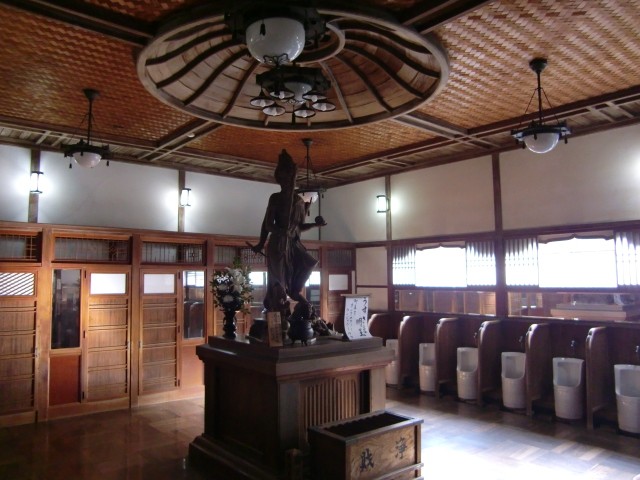
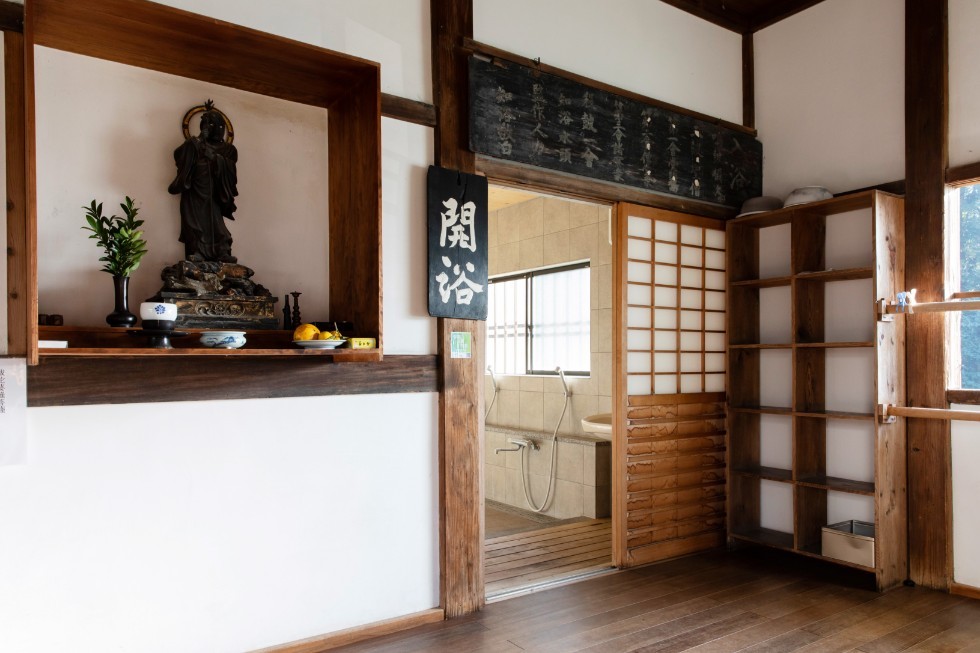
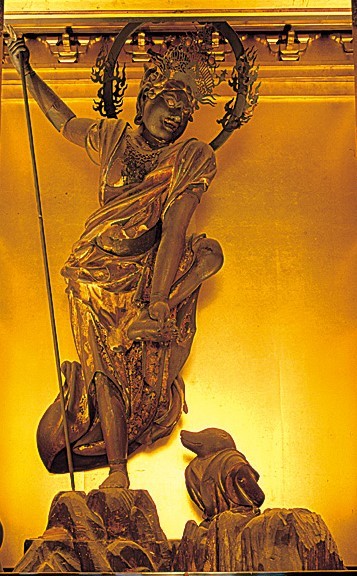
The image there is the Buddha Ususama-myoo (烏瑟沙摩明王, seen below at the entrance to another Tosu and bath house), also called Katokongoo, who symbolizes the virtue of purification, and is said to transform impurities. It is also said that the origin of Ususama Myo-oh is the Indian god Agni, able to burn away all impurities with fire.
LESSON 4: BOWING
We have some bowing and prostrations during our annual retreat. To be more precise, there are times of prostrating (Raihai) which can be replaced with standing bow (Gassho) if physical need, and these are done in a series of three (Sanpai)
Many Westerners don’t care for it, because it is not part of our culture generally. We see it as humiliating, embarrassing, somehow “idol worshipping” or undemocratic. The most often asked question is to whom or to what we are bowing. Is it to some thing, god, place like Mecca, person or effigy?
The answer is that there is nothing that’s true that is omitted from our bow. We might consider that we’re simply bowing to the whole universe, and to ourself and the other people around us … after all, ‘All is One’! The hands, palms upwards from the ground, are raised in a gesture traditionally symbolic of lifting the Buddha’s feet over one’s head, but that truly means lifting all things of the universe over one’s head as all things support you in turn. It’s appropriate to cultivate an attitude of emptying, letting go, receptivity and gratitude in our bows.
We do not necessarily need to think anything when bowing … although we might feel in our hearts that “Great Gratitude” we sometimes mention.
If there is some physical or personal reason not to prostrate, a simple deep standing Gassho can be substituted. For those who must be in bed, a sincere hand gesture or wink can hold all the sincere heart of a full bow if the heart means it so. All that matters is that there is present the sincerity and the humility of the prostration.
No less, are we raising something up or … seen another way … is the whole world raising us up at the same time?
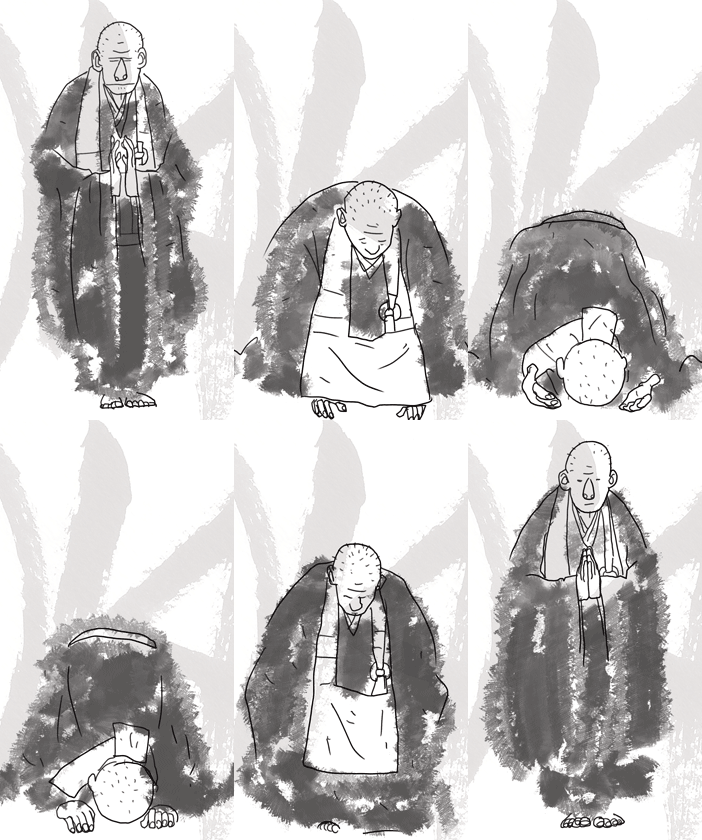
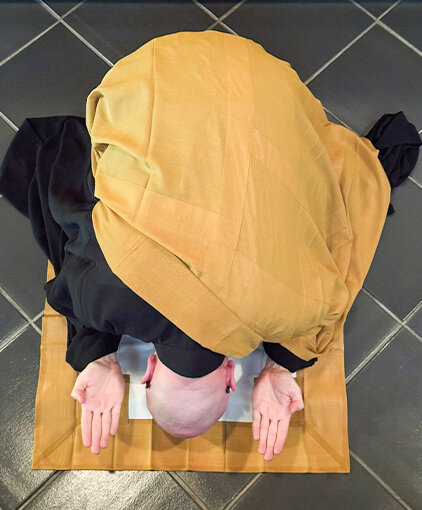
Here is a graphic explanation of how to perform a prostration. This is one of the essential forms in our tradition:
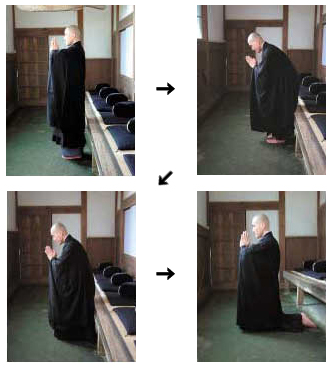
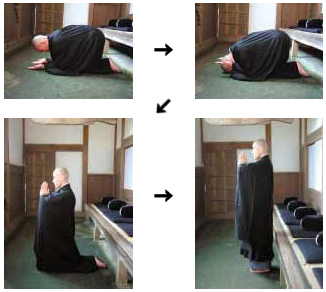
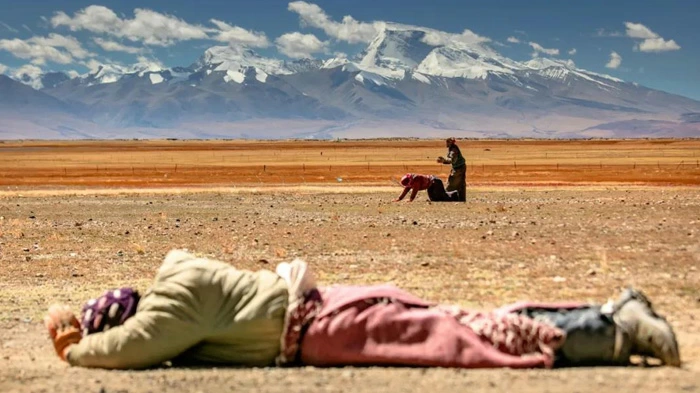
Many Tibetans (many Christians pilgrims too) will travel for hundreds of miles, prostrating with each step …
PHYSICAL PREPARATION AND CARE
Here’s a very basic, gentle practice that is closer to the “warm-up” portion of a longer yoga class. You can do this either seated on the floor or in a chair, and both verbal and visual cues for both options are provided (via a picture-in-picture approach).
We suggest that if you’re interested, you should review the video BEFORE the retreat to familiarize yourselves with the notes and the practice. You can then jump right to the practice portion when needed and/or simply weave some of the poses/stretches into your retreat experience wherever it feels right for you. The practice itself is less than 20 minutes in duration. The first 5 minutes of the video are taken up by some opening credits/disclaimer (important for any online yoga “class”) and Seikan’s opening notes on how to prepare for the practice
CLOSING WORDS
If you would like to watch a brief video of formal Sesshin atmosphere (not much different on ordinary days there in fact) at Eiheiji Monastery, including such customs as Samu Work and Oryoki …
… in our Treeleaf Retreat we try to bring a taste of such into our own homes and daily life …
Our way is certainly not as rigorous as the life of these young monks in training. However, do not think that such a place is more and our way is less, for we can sit and work and eat beyond and right through all measures and distinctions. Our way is not quite the same, but neither is it different in the least. It is our belief that one can encounter the same lessons, the same freedom, the same opening of the mind even in our little Retreat if one knows how to look within and without, free of mental border. Our own life can be a place of good Practice, and a source of Wisdom and Compassion, as much as any monastery. Your life too, right where you sit and work at a job and take care of your family and social responsibilities is Relentless Practice.
As Jundo Roshi always tells our priests-in-training here at Treeleaf, the seriousness of the Practice depends on one’s own diligence, care, persistence, sincerity and attention to the Practice before one in this moment.
Zazen is not a matter of long or short. One must sit dropping all measure, tasting in one’s bones that every single instant of Zazen is all time (and all timeless too)! One must sit throwing the clock away! And yet, and yet … sometimes, we need to practice a bit long and hard, morning to night, sitting and wrestling with ‘me, my self and I’, all to attain ‘Nothing More to Attain’, and to taste ‘Just This’. It is also not a matter of place … s we should “sit Zazen” too in the hospital bed, death bed, nursery room, grocery line, city bus. Nonetheless, we go to the Retreat sometimes to sit in a room on a Zafu, precisely because it is not a matter of “where” or “place.”
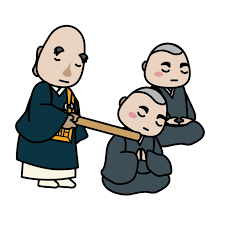
Our Retreat may be short by the clock and held from home, but can be a serious endeavor nonetheless. And, no…we will not be hitting anyone with the Kyosaku stick
Nine Bows to All Who Sat This Retreat Together