
| home practice
Buddhist Holidays in the Family

Welcome to our Buddhist Family Holidays project! Most of our sangha live in parts of the world that are primarily non-Buddhist. This presents a challenge, but also an opportunity, to celebrate our practice amidst other religious and cultural traditions. We have three goals with this project:
- To learn and observe Soto Zen Buddhist holidays for ourselves
- To learn and observe comparable holidays in other traditions, when possible, with those who are dear to us
- To offer our customs and traditions to our children in a more accessible format
Holidays are a chance to slow the pace of our lives, reflect, and practice gratitude for all things. They can also be stressful, however, especially if our beliefs conflict with those of those around us. Yet at heart, all holidays of peace, goodwill, family and gathering share many of the same values. We can honor and join our loved ones’ customs, and find a shared spirit with our own. In my own life, this has been a process of learning that the symbols we use in different traditions are not as vital as I thought. At times, we can keep our ways in our own hearts, being gentle and patient with others, even when those people may be less patient with our ways. At other times, we can celebrate all ways together!
“If those who teach Buddhism in the West keep in mind that all dharmas are Buddhadharma, they will not feel like a drop of oil in a glass of water. If you practice in exactly the same way we practice in Vietnam, Tibet, Thailand, Burma, Sri Lanka, Japan, or Korea, the oil drops will always remain separate from the water.” – Thich Nhat Hanh
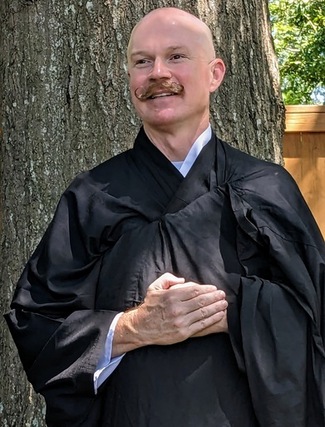
I’ve been a member of Treeleaf since 2010, and am married, with two teenage sons. I live in a wonderful, mixed faith family in which my wife and oldest child are Methodist Christian, while my youngest son and I are Soto Zen Buddhist.
Holidays


NEW YEAR’S DAY (LUNAR OR SOLAR)

Celebrating the new year is a world wide custom, and there’s not anything particularly Buddhist about the idea. The date and type of celebration vary depending on where it’s observed, however. For most of the Western World, New Year’s Eve/Day is commemorated according to the Gregorian Calendar, which is based upon the Earth’s movement around the sun. In many Asian countries, however, lunar cycles determine the start of a new year. This results in the lunar new year being on a different day each year. For 2026, the lunar new year is on February 17th.
We have a few established ways of commemorating the New Year in the West, but here a couple of interesting customs from Japan:
Oosouji 大掃除 (big cleaning) takes place between December 13th and 28th, involving a thorough cleaning of homes and offices. Another healthy practice is to watch the first sunrise of the year (hatsuhinode 初日の出 ) 1
Depending on one’s family dynamic, sitting zazen to mark the new year may be appealing. Whatever you choose, it’s important to bring a spirit of moderation and gratitude to the occasion. It’s easy to be swept up in the excitement of another year, and want to change our habits. Lasting change is moment by moment, however, which is timeless.
How do you celebrate the new year?

NEHAN-E (BUDDHA’S PARINIRVANA DAY)
February is a time of remembrance and celebration for Nehan-e (Parinirvana Gathering), the traditional observance of the historical Buddha’s passing from this visible world. It is also a time for each of us to remember, in our own homes, family members and friends who have gone before us. While this observance is traditionally held on February 15th in Japan, our Sangha and many others will celebrate during the week surrounding this date.
So, what is Nehan-e?
This day commemorates the passing of Shakyamuni Buddha near the town of Kushinagara, on the banks of the Hiranyavati River. To mark the occasion, a large scroll or statue depicting the Buddha entering Nirvana is displayed, and a ceremony of gratitude to the Buddha is performed. The Sanskrit term “Nirvana” literally means “extinction”—specifically, the extinction of worldly illusions and passions. Wherever such extinction is realized, there is calm and peaceful Nirvana. On this particular day, however, the term refers specifically to the physical death of Shakyamuni Buddha.
It is said that at the time of his death, the Buddha was lying on a bed prepared between two sala trees, his head to the north, his face to the west, and his right hand serving as a pillow. In that moment, white flowers blossomed on the sala trees and fell without ceasing. Many of his disciples—men and women of all ages—as well as birds and animals, gathered around him, sighing with sorrow.
The Buddha then delivered his final discourse, teaching the fundamental truth that although the physical body dies, the Dharma is timeless and unbounded; to truly see the Buddha is to see the Dharma. In this way, he instructed his disciples in the Precepts and in how they should continue the practice of the Buddha Way. This sermon is known as the Yuikyōgyō, the Last Teaching of Shakyamuni Buddha (or “Sutra of the Last Teaching Bequeathed by the Buddha”).
He passed away at the age of eighty and entered Mahāparinirvāṇa—a state that cannot in any real sense be “entered” or “departed”—the absolutely free state of enlightenment.
Though we mark events from some twenty-five centuries ago, in lands far away, this moment itself is beyond measure or time—present here, and in all places.
So it may be that we meet our lost loved ones and friends as neither gone nor distant, but beyond time—present here, and everywhere.
Parinirvana Ceremony
(At home portion)
This Portion is to be conducted, should you wish, at each family’s home on an evening of your choosing.
Begin by framing an image of the “Reclining Buddha” (Buddha on His Death Bed). There are many available online, or you could use the one available below.
At home, after dark, place the framed picture on a table as a small altar. Set an incense burner in front of the picture of the Buddha and/or candles—either in front of the picture if used alone, or to the sides of the incense if used together. Place photographs or other reminders of the loved ones and friends to be remembered to the right and left of the Buddha’s image. Surround the arrangement with fresh flowers and/or fruit, such as apples or oranges, and place a small cup of sweetened water or tea as an offering to quench all thirst.
You may also place a small toy on the table for any children whose passing is being remembered.
Family members gather, dressed neatly. They may stand in gassho or simply stand respectfully, while one adult representing the family lights the incense and/or candles, offers three standing gassho bows, and, holding the paper in the manner shown below, recites the following before the image of the Buddha:

“This is the day of the Buddha’s Parinirvana, the time some 25 centuries ago when the Thus Come One entered Parinirvana, Final Nirvana, the day of the historical Buddha’s passing from this visible world. With each passing day, let us cherish life. Mindful of transiency, let us live this life and pursue our Path with diligence and care.
We remember our dear (say as applicable, and add their first names where possible) parents, grandparents, siblings, our relatives near and distant, all our ancestors reaching back through the generations, and our dear friends and other cherished ones who have passed from this visible world. All in their way, by their lives, made our lives in this present moment possible and are the root of our being. They supported us, befriended and nurtured us, each in their way, both in ways clearly seen and ways sometimes obscured and hidden to our eyes. To each we express and offer our caring, boundless love, greetings, embrace, gratitude, mutual understanding and forgiveness, tolerance and hope for their peace and rest.
As was taught in the Sutra of the Last Teaching Bequeathed by the Buddha, spoken by the Tathagata with regard to his own passing …
O good followers of the path! Do not grieve! Even if we were to live in the world for as long as great aeons of time, our coming together would someday have to end. There can be no coming together without parting. A life that benefited both self and others has reached completion. What has been said, has been said. What has been done, has been done. Even if we were to live longer, there would be nothing to add. …
Therefore, you should know that all things in the world are impermanent; coming together inevitably means parting. Do not be troubled, for this is the nature of life. Live and Practice diligently with right effort, find liberation immediately and, with the light of wisdom, remove the darkness of ignorance. Thus the Body of the Tathagata’s Dharma will be realized as timeless and indestructible. Yes, nothing is secure, and everything in this life is precarious. Yet, do not think that “The light has ceased.” It should not be seen like this. For what I have lit shall be your light, all living beings shall be the light, this bright world, and your very mind itself, shall be this same light continuing on.
Now, good followers of the way! You should always wholeheartedly seek the path of liberation. Yes, all things in the world, whether moving or seemingly non-moving, are characterized by disappearance and instability. Yet, be as lamps unto yourselves and pass on that light throughout generation after generation and to everyone in this world.
Stop now! Do not speak! Time is passing. I am about to cross over. This is my final teaching.”
FOR FAMILIES SPECIFICALLY REMEMBERING THE PASSING OF A CHILD, BORN OR UNBORN:
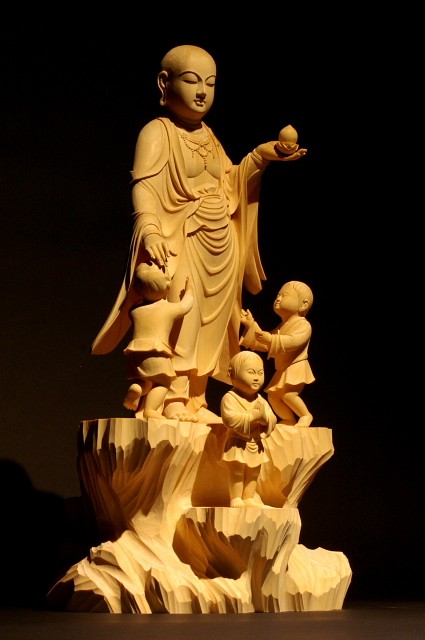
Begin by placing on your altar a picture of Jizo Bodhisattva, the protector of children—either a printed and framed image or a simple hand-drawn version. Next, add one or two small items for the child, such as candy, a simple toy (like a ball or small doll), or a small piece of children’s clothing.
After the ceremony, eat the candy yourself, consciously taking it into your body and tasting the sweetness of life. You may keep the toy or clothing and store it in a special place, as a remembrance and for use in any future ceremonies.
The family member leading the ceremony begins by announcing: “A moment of silence will now be held in memory of those commemorated here—our ancestors and friends who have departed this visible world.”
After the moment of silence, the family leader offers a few heartfelt words in a relaxed, conversational tone, speaking in memory of those being honored. They may remember some individuals by name and others more generally, sharing stories or reflections with everyone gathered—especially any children—about the people being remembered.
This short talk should center on themes of love, friendship, gratitude, and, where needed, forgiveness of the past.
The ceremony concludes with the words: “We will carry each of you in our hearts, and wish peace to you and peace to all who remain behind.” This is followed by three standing gassho bows, marking the end of the ceremony.
The home altar should remain in place until after sundown the next day. For safety reasons, candles should not be left burning after the ceremony.
NOTE: If desired, and in consideration of the religious sensibilities of other family members, images of the Buddha and the use of incense may be omitted. The content of the ceremony and references to the Buddha can also be modified as appropriate.
VESAK
This is one of two major holidays in our sangha, and commemorates the birth of Shakyamuni Buddha. Like many spring holidays, it also celebrates the emergence of life after winter’s passage. Treeleaf observes Vesak on April 8th, though it falls on different dates in other Buddhist traditions. Vesak is a great opportunity to celebrate with family, especially children. If you want to learn more about the history and meaning of Vesak, you can listen to Domyo Burke from the Zen Studies Podcast. Here are some activities you can do together:
BATHING THE BABY BUDDHA
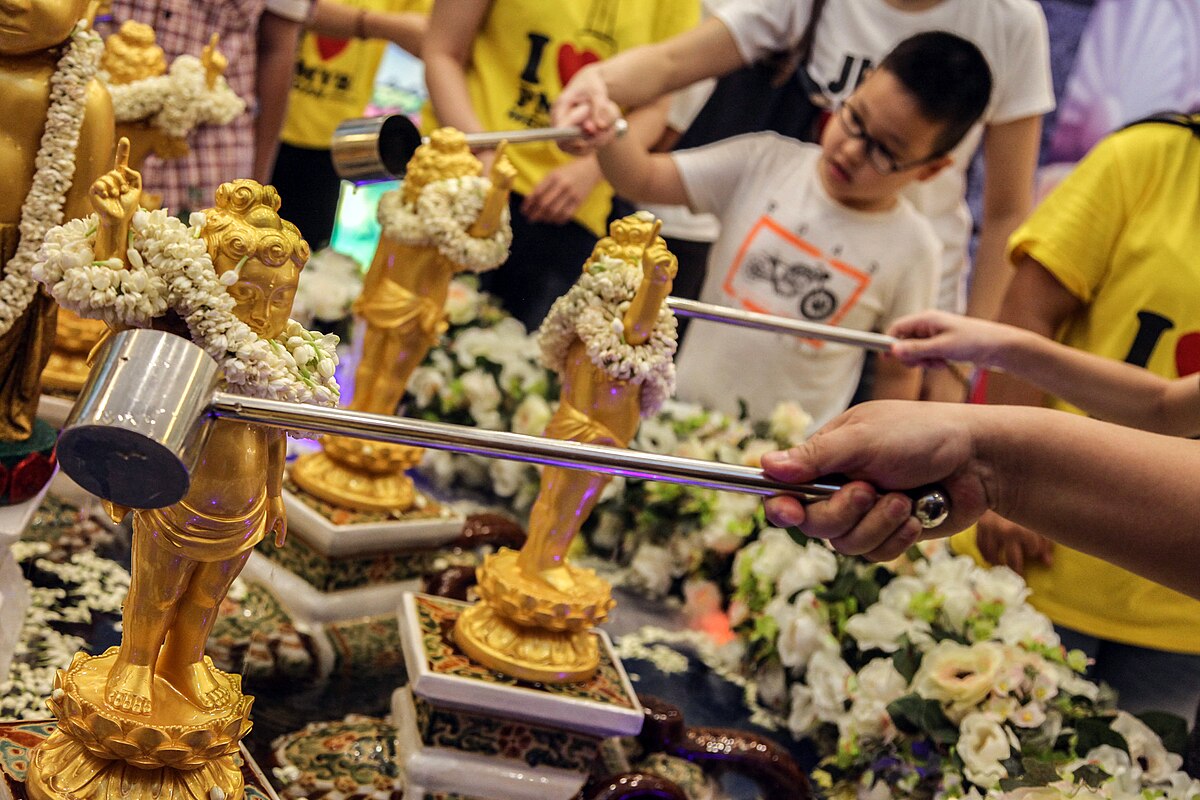
On the day of Vesak, participate in a ceremony (with your Sangha and priests, or at home with your family) in which all participants bathe a figure of baby Buddha in tea or fragrant water. This tradition is found in many Buddhist cultures and traditions.
Buddhist stories and traditions tell the tale of how, when the Buddha was born, he immediately took seven steps and declared “I alone am the World-Honored One,” pointing up with one hand and down with the other to indicate that he would unite heaven and earth. Some say that the seven steps represent seven directions — north, south, east, west, up, down, and here — standing for all reality. Mahayana Buddhists often interpret “I alone am the World-Honored One” such that “I” represents all sentient beings throughout space and time — everyone in other words. Many other good and positive meanings and teachings can be found in such stories.
The ritual of “Bathing the Baby Buddha” celebrates this moment. It is said to be the single most common ritual in Buddhism, seen throughout Asia and in many different schools. A small standing figure of the infant Buddha, with the right hand pointing up and the left hand pointing down, is placed on an elevated stand within a basin on an altar. People approach the altar reverently, fill a ladle with clear water or tea, and pour it over the figure to “wash” the baby.
Below are examples of such a ceremony: both a simple version for at home and a longer version for adaptation by Buddhist Sanghas.
If you cannot find a traditional statue of the Baby Buddha, make one with your kids! Find a large, smooth stone and help your child/children paint a figure of Baby Buddha on it. In fact, why not take an ordinary child’s baby doll and, with reverence and respect, dedicate it to serving as the Baby Buddha?! The sincerity of our doing so is found in the heart.
VESAK LANTERN CRAFT
Make Vesak lanterns with the kids! Each family member can make one to symbolize both the Buddha’s light and the light within each of us that, when united together, can truly brighten a small space and our whole world. It also symbolizes the moment at which Buddha found the Truth and became enlightened. The lanterns (or candles in their place) can be lit each night for the week leading up to the day of the Buddha’s birth, together with a family chant of the Three Refuges.
We take refuge in Buddha
We take refuge in Dharma
We take refuge in Sangha
Every night for the week before April 8th, light the lanterns or 3 candles at dinnertime while reciting the Three Refuges, to signify Buddha’s search to end the impurities of greed, anger, and ignorance, and to symbolize the three treasures: Buddha, Dharma, Sangha.
CELEBRATING NATURE
Vesak is a holiday of birth, new beginnings, and hope for our world. If the weather permits, go outside with your family and spend time in nature. Work together to make a bird feeder or birdhouse and hang it outside your home to help feed and shelter other living creatures.
Visit a park for a picnic with friends in the Dharma and loved ones. Take a walk, enjoy the scenery together, and then spend some time picking up trash and cleaning a natural area. This is a meaningful way to show your children how important it is for all of us to work together to keep our world clean.
April is also the month that includes Earth Day, and volunteer activities in honor of that day are another way to honor the Buddha. Plant something with your children to symbolize life, birth, and rebirth. This could be a tree, flowers to share with someone once they bloom, or flowers for your own family to enjoy. You could also start an herb garden so your children can witness the magic of life as it grows, and then see how it can nourish our bodies.
DHANA
As a family, make a donation of money, food, clothing, or other items to a food bank, shelter, or other charitable organization. Ideally, the money should be earned by the child through their own work or chores, and then used for the donation—either directly or to purchase food and clothing. Either take your children to the facility to drop off the items, or ask them to contribute a portion of their chore, holiday, or spending money to donate to a cause your family chooses. You can also make soup or another type of meal to deliver to a sick or elderly neighbor and, if possible, spend time visiting together as a family. It is vital to teach children that charity, generosity, and giving are important all year round.
BIRTHDAY PARTY FOR BABY BUDDHA
Celebrate the holiday with a typical child’s birthday party, but with the baby Buddha as the birthday boy! Invite others, especially Buddhist children. Cake and ice cream (in moderation!), songs and games (Pin the Tail on the Elephant, Musical Zafus a White Elephant Hunt*), and all the typical birthday party events. Combine with some other holiday suggestions, such as Vesak Lantern Making and Tree Planting. Sing “Happy Birthday to You, Dear Buddha” … blow out “the Candle of Desire”, making a wish … not for oneself … but for others’ peace and happiness.
*Much like an egg hunt, families with small children could enjoy an “ELEPHANT HUNT” – elephants because Siddhartha’s mother dreamt of a white elephant while she was pregnant with him. Elephants are cute for young kids, who would enjoy them. You can cut out paper elephants for your kids to color (as many as you’d like). Or you can find plastic or wooden elephants to use – it doesn’t matter what they’re made of. Number them – each number will correspond to a task, a treat to give to other kids, or another game for tall he children after the hunt. If you use paper, you can write these things on the back. The tasks can include anything you want, examples may be: go to lunch/breakfast with dad or mom (the idea is only one parent, so they have quality time with that person), help mom/dad with the dishes, laundry or trash, make a gift for a neighbor or friend, play a game (of your choice) with your family, make a birdhouse/birdfeeder with dad. The idea is to get children thinking about doing things for, and with, other people and not about “getting” a present for themselves.
If you have older children who may not enjoy the elephant hunt, then create a scavenger hunt to symbolize how Buddha left home in search of the Truth. The scavenger hunt should be a fun search that all family members can do together, but should somehow relate to what the Buddha went in search of.